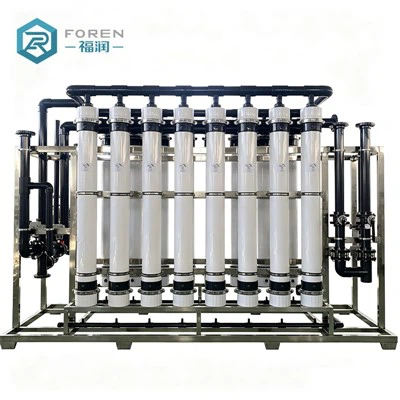

Reverse osmosis membrane separation technology utilizes the principle of reverse osmosis membranes for separation and has the following significant advantages:
It can separate solutes and water under conditions where no phase change occurs at room temperature, making it suitable for the separation and concentration of heat-sensitive substances. Compared to separation methods involving phase changes, it consumes less energy.
Reverse osmosis membrane separation technology has a wide range of impurity removal capabilities.
It offers high desalination and water reuse rates, and can retain solutes with particle sizes of several nanometers or larger.
It uses low pressure as the driving force for membrane separation, resulting in simple separation equipment, easy operation, maintenance, and automation, and a safe and hygienic on-site environment.
Application Areas: Reverse osmosis membrane technology is widely used in industries such as power plant boiler feedwater, ultrapure water treatment in the electronics and semiconductor industries, pure water treatment in the chemical and pharmaceutical industries, food, beverage, and drinking water treatment, seawater and brackish water desalination, and wastewater treatment in metallurgy, light industry, electroplating, and leather industries.