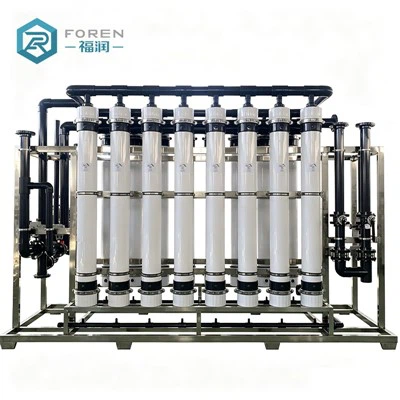

Your Leading Seawater Desalination PlantSupplier
Qingzhou Foren Water Treatment Equipment Co., Ltd. is a professional manufacturer specializing in the research and development (R&D), production, and sales of water treatment and filling equipment. Our main products include a wide variety of water treatment equipment, such as reverse osmosis systems, UF system/NF systems, EDI equipment, water softener systems, wastewater recycling systems, containerized water treatment systems, seawater desalination plants, and water treatment equipment accessories, providing integrated solutions for the water treatment, industrial water treatment, beverage, and pharmaceutical industries.
-
![Seawater Reverse Osmosis System]() Seawater Reverse Osmosis SystemSeawater reverse osmosis systems utilize the principle of reverse osmosis to separate water. Because the reverse osmosis membrane has a dense barrier layer, it typically only allows water...view more
Seawater Reverse Osmosis SystemSeawater reverse osmosis systems utilize the principle of reverse osmosis to separate water. Because the reverse osmosis membrane has a dense barrier layer, it typically only allows water...view more -
![Seawater Desalination RO System]() Seawater Desalination RO SystemAs a mature and efficient water treatment solution, the seawater desalination RO system has become the most reliable mainstream choice for sustainable on-site freshwater production in coastal and...view more
Seawater Desalination RO SystemAs a mature and efficient water treatment solution, the seawater desalination RO system has become the most reliable mainstream choice for sustainable on-site freshwater production in coastal and...view more -
![Seawater RO System]() Seawater RO SystemLeveraging mature reverse osmosis water treatment technology, Foren factory has independently developed and integrated a containerized miniature seawater RO system.view more
Seawater RO SystemLeveraging mature reverse osmosis water treatment technology, Foren factory has independently developed and integrated a containerized miniature seawater RO system.view more -
![Brackish Water Reverse Osmosis System]() Brackish Water Reverse Osmosis SystemOur brackish water reverse osmosis system is considered one of the most compact industrial reverse osmosis systems on the market. It utilizes advanced energy-saving membranes and features a robust...view more
Brackish Water Reverse Osmosis SystemOur brackish water reverse osmosis system is considered one of the most compact industrial reverse osmosis systems on the market. It utilizes advanced energy-saving membranes and features a robust...view more -
![Seawater Desalination System]() Seawater Desalination SystemFOREN's seawater desalination systems achieve high-quality reverse osmosis desalination. Seawater is siphoned into the system from the ocean, pre-treated by filtration to remove most particles,...view more
Seawater Desalination SystemFOREN's seawater desalination systems achieve high-quality reverse osmosis desalination. Seawater is siphoned into the system from the ocean, pre-treated by filtration to remove most particles,...view more


Why Choose Us?
Integrated Solution Capability
We provide end-to-end solutions covering system design, equipment supply, installation, and after-sales service, helping customers streamline project execution.
Proven Industry Experience
We have established long-term cooperation with domestic and international clients, supported by extensive project experience in water treatment and filling systems.
Reliable Product Performance
Our systems are designed for stable operation, energy efficiency, and easy maintenance, ensuring long-term and cost-effective use in various industries.
Quality Assurance and Compliance
We operate under ISO 9001 standards, with strict testing and inspection processes to ensure consistent quality and reliable performance.
Types of Seawater Desalination Plant

Brackish Water Reverse Osmosis System
Our brackish water reverse osmosis system is considered one of the most compact industrial reverse osmosis systems on the market. It utilizes advanced energy-saving membranes and features a robust structure, automated design, environmentally friendly operation, and long-term reliability.

Seawater Reverse Osmosis System
Seawater reverse osmosis systems utilize the principle of reverse osmosis to separate water. Because the reverse osmosis membrane has a dense barrier layer, it typically only allows water molecules to pass through while preventing solutes from passing.

Seawater Desalination System
FOREN's seawater desalination systems achieve high-quality reverse osmosis desalination. Seawater is siphoned into the system from the ocean, pre-treated by filtration to remove most particles, and then passed through a reverse osmosis membrane to effectively remove salt and contaminants.
Specifications of Seawater Desalination Plant
|
Parameter |
Description |
|
Capacity Range |
10 m³/day – 50,000 m³/day (customizable) |
|
Desalination Technology |
Reverse Osmosis (SWRO) |
|
Feed Water Source |
Seawater (TDS up to 35,000–45,000 ppm) |
|
Recovery Rate |
35% – 50% (depending on water quality and design) |
|
Product Water Quality |
< 500 ppm TDS (drinking water standard achievable) |
|
Pre-treatment System |
Sand filter, multimedia filter, UF (optional), chemical dosing |
|
High Pressure Pump |
Stainless steel, energy-efficient design |
|
RO Membrane |
Optional (Dow, Toray, Hydranautics or equivalent) |
|
Energy Consumption |
3.0 – 6.5 kWh/m³ (depending on system design) |
|
Energy Recovery Device |
Optional (PX / turbine type) |
|
Control System |
PLC automatic control with HMI |
|
Pipe Material |
UPVC / Duplex SS / SS316 |
|
Cleaning System |
CIP (Clean-In-Place) system included |
|
Installation Type |
Skid-mounted / Containerized / Civil plant |
|
Operating Temperature |
5°C – 45°C |
|
Power Supply |
220V / 380V / 415V, 50Hz / 60Hz |
|
Compliance |
WHO drinking water standards, CE, ISO (optional) |
Characteristic of Seawater Desalination Plant

Durability: The desalination system uses high-quality equipment materials, and its internal structure is strong enough to withstand the harsh marine environment. The system should be durable and not easily damaged to affect its use.
Reliability: The machinery can be capable of performing consistently and dependably, especially under difficult circumstances like excessive salinity or erratic water flows.
Efficiency: With little energy input, the system should be able to generate significant amounts of fresh water. This is crucial for the system' s cost-effectiveness as well as for lowering its environmental impact.
Environmental impact: The system' s operation should have a negligibly small impact on the environment, both in terms of the energy needed to run it and the waste products it generates.
Flexibility: This desalination system should be able to adjust to various water sources and environmental factors, such as shifting water currents or variable salinity levels.
Basic Components of a Seawater Desalination Plant
|
Component |
Function |
|
Intake System |
Extracts seawater from the source, typically using intake screens or wells. The intake system will have a flow rate associated with it. |
|
Pretreatment System |
Removes suspended solids, algae, and other organic/inorganic impurities to protect downstream membrane equipment. Natzeo filter media is commonly used to remove the large particles. |
|
High-Pressure Pumps |
Increases seawater pressure to overcome osmotic pressure in reverse osmosis systems. The feed pumps must be designed to deliver the required feed pressure for the RO membranes to operate. High-pressure pumps are needed in reverse osmosis desalination plants. The pumps increase the feed water pressure to a level that will force the water molecules through the RO membranes. |
|
Reverse Osmosis Membranes |
Removes dissolved salts and other impurities by allowing water molecules to pass through. The pressure vessels house the membrane elements. The membrane pressure is what drives the separation process. The higher the pressure, the higher the permeate flow. |
|
Energy Recovery Device |
Recoups energy from the reject stream (concentrate flow), lowering the overall energy consumption of plant operation |
|
Post-Treatment System |
Adjusts pH, adds disinfectants, and remineralizes desalinated water to meet design criteria standards. |
|
Brine Discharge System |
Disposes of the concentrated saltwater (brine) back into the environment responsibly. The brine discharge system must be carefully designed to minimize the environmental impact. The salinity of the concentrate flow is much higher than the naturally occurring seawater. A recovery design that includes a specialized brine diffuser is commonly used to mix the concentrate with seawater prior to being discharged back to the ocean. |
|
Control and Monitoring System |
Automates plant operations, monitors performance, and ensures efficient desalination processes. |
Workflow of Seawater Desalination Plant

Cleaning Steps for Seawater Desalination Plant


Determine When to Clean
Cleaning should be scheduled when any of the following conditions are met: a 10-15% decrease in permeate flow; a 15% increase in inter-membrane pressure differential; a decrease in desalination rate of more than 5%; or a signifcant increase in permeate TDs. Do not wait until the performance deteriorates signifcantly before cleaning; when the water production drops by 15-20%, the membrane damage is irreversible.
Select Cleaning Chemicals Appropriate for FoulingType
Before cleaning, it is necessary to determine the type of contaminant and the corresponding cleaning agent. High SDl in the influent and a muddy appearance on the membrane surface indicate colloidal fouling.
White crystals on the surface indicate inorganic scale, which should be treated with an acidic agent with a pH of 2-3. A slimy surface with an odor indicates biological fouling, which should be treated with an alkaline agent with a pH of 10-11and a surfactant.
CIPCleaning Process
The most common cleaning method for SWRO systems is Clean-In-Place(CIP). Without disassembling the membrane element, contaminants on the membrane surface are removed using circulating chemical agents, restoring membrane performance.
Post-Cleaning Rinse &Restart
Flush with RO permeate until the effluent pH is neutral and the conductivity is close to the influent level. Flushing must be thorough, as residual chemicals can affect subsequent operation, and swRO systems require a longer flushing time.
Cleaning Frequency
Generally, SWRO systems need to be cleaned once every quarter to six months, but the triggering conditions in Step 1 should be used as the standard.
If the cleaning effect is restored to 90% or more, continue with the existing strategy. If it's restored to 80-90%, check if the cleaning was done too late or if the wrong cleaning agent was used. If it's restored to less than 80%, it indicates the contaminants are irreversible, and the next cleaning should be done earlier.
Payment Terms
T.T with 30% downpayment, 70%before shipment. Paypal or West Union also accept.
Packing & Transportation
|
Category |
Details |
|
Packaging Method |
Container loading;protective film wrapping; wooden crates; reinforced with steel bars. |
|
Transportation Method |
Sea freight (preferred for large items); |
|
Air freight (for emergency spare parts). |
FAQ
As one of the most professional seawater desalination plant manufacturers and suppliers in China, we offer a wide range of products with superior quality. Please feel free to buy customized seawater desalination plant made in China here from our factory. Contact us for quotation.
sea water desalination machine, Brackish Water Reverse Osmosis System, sea water intake system