
Wastewater Recycling
Some Western countries have used various methods to treat wastewater, but the results have been unsatisfactory, failing to address the root causes of the problem. Furthermore, the relatively low cost of ultrafiltration equipment provides a strong foundation for wastewater recycling. In fact, wastewater discharged from municipal sewage treatment plants and factories can be reused after treatment; however, such practices are not readily accepted by Western users. Windhoek has previously used membrane technology to reuse effluent from wastewater treatment plants as drinking water.
Surface Water Treatment
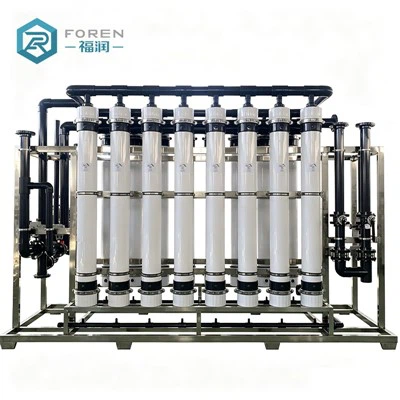
Ultrafiltration equipment is mostly used for surface water treatment. The treated water is used for irrigation or as feed water for reverse osmosis to produce industrial water. The number of such plants is gradually increasing in places like the Netherlands. This technology provides access to nearby surface water without the need to purchase increasingly expensive drinking water.
Drinking Water Treatment
As living standards improve, people have higher requirements for drinking water quality. Water treatment companies focus on controlling the amount of microorganisms present in water supply networks. To achieve this, one method is to stop expensive and frequent water quality testing, or to install barriers at the water supply terminals to prevent the entry of bacteria and viruses. Using a UF system, it's very convenient to build such a barrier. Ultrafiltration membranes can achieve a bacterial removal rate of 6 log and a virus removal rate of 4 log, so water plants and users don't need to worry about bacteria and viruses. Because the drinking water quality is already very high, the membrane system can use a very high membrane flux, reaching 135 liters/m²·hour. At the same time, the high feed water conditions mean that the backwashing frequency and chemically enhanced backwashing frequency can be very low, and the permeate yield can reach 99%. If needed, a secondary ultrafiltration unit can be installed to further reuse the backwash water from the first stage.
Seawater Desalination: The Middle East is one of the regions most severely lacking in water resources. To solve this problem, distillation techniques were initially used. Since the 1860s, membrane technology has been used to address the water shortage problem in these countries. However, many reverse osmosis seawater desalination (using semi-permeable membranes to desalinate seawater) systems face the problem of severe membrane fouling. This is primarily because traditional pretreatment methods for reverse osmosis systems cannot provide reliable feed water quality. Consequently, most desalination plants operate at far below their designed output, with some even achieving less than 30% of their final design capacity. Research on small-scale desalination units shows that ultrafiltration systems can supply high-quality feed water to reverse osmosis systems based on controllable seawater quality. Durability tests also demonstrate that the SDI value of ultrafiltration system effluent can be well controlled below 2. These tests are conducted without any pretreatment before the ultrafiltration system (also known as an ultrafiltration unit) and are applicable to various seawater qualities.