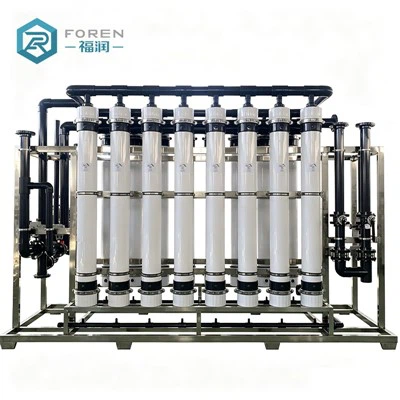

With years of on-site customization, installation, and after-sales debugging experience in the water treatment industry, we at Qingzhou Foren Water Treatment Equipment Co., Ltd. have encountered countless equipment selection cases. Reverse osmosis (RO) equipment serves as the core desalination facility in the entire water treatment system, widely applied in industrial pure water preparation, seawater desalination, reclaimed water reuse, commercial drinking water purification and many other scenarios. During our long-term service, we have found that most customer equipment failures, unstable water quality and low operating efficiency stem not from equipment quality problems, but from inappropriate model selection and mismatched configuration. Faced with numerous RO equipment models and diversified parameter configurations on the market, scientific and targeted selection is particularly critical.
Based on our practical project experience, the premise of selecting a suitable RO equipment model is never blind pursuit of high configuration or low price, but accurate matching according to actual raw water quality and water demand. The first and most essential step is to rely on an official raw water quality analysis report. In all our project customization services, we will first guide customers to complete raw water quality testing, and focus on three core indicators: TDS, water hardness and SDI value, which basically determine the entire configuration scheme of the RO system.
We have summarized clear selection rules for TDS indicators through long-term on-site verification. TDS content directly dictates the operating pressure range and membrane type of the RO system. For conventional raw water with TDS below 500 mg/L, low-pressure RO membranes can be adopted to meet water production demand and reduce equipment operating energy consumption; for brackish water with TDS ranging from 500 mg/L to 2000 mg/L, standard brackish water membranes are the most matching option with stable desalination performance; for special water sources such as seawater with TDS exceeding 10000 mg/L, professional seawater desalination membranes must be configured, otherwise the membrane elements will be overloaded and scrapped in a short time.
In actual customer projects, water hardness is an indicator that is extremely easy to be ignored but causes the most serious consequences. We have tracked many failure cases: when raw water hardness exceeds 200 mg/L without supporting pretreatment facilities, membrane elements will produce a large amount of scale in only 3 to 6 months, resulting in reduced water production, decreased desalination rate and irreversible blockage. Therefore, we will compulsorily match water softener or scale inhibitor dosing system for customers with high-hardness raw water in our scheme design to eliminate scaling risks from the source. In addition, the SDI value, which reflects water turbidity and impurity content, also has a strict threshold standard summed up from our experience: equipment cannot be directly fed with raw water when the SDI value is greater than 5, and targeted optimized pretreatment must be equipped to intercept colloids, suspended solids and other impurities, so as to protect the core RO membrane components.
On the basis of qualified water quality matching, the actual required permeate flow rate is another core basis for us to select equipment specifications for customers. At present, industrial RO membranes are mainly divided into two mainstream specifications: 4-inch and 8-inch, with completely applicable scenarios. The conventional 4040 specification 4-inch membrane has a single-membrane water production capacity of 0.25-0.4 m³/h, which we usually recommend for small factory supporting systems, laboratory pilot equipment and small-scale commercial water purification projects, featuring small footprint and flexible operation. The 8040 specification 8-inch membrane, with a single-membrane water production capacity of up to 11.5 m³/h, is our standard configuration for medium and large industrial water treatment systems, which can efficiently meet continuous and large-volume water production demand.
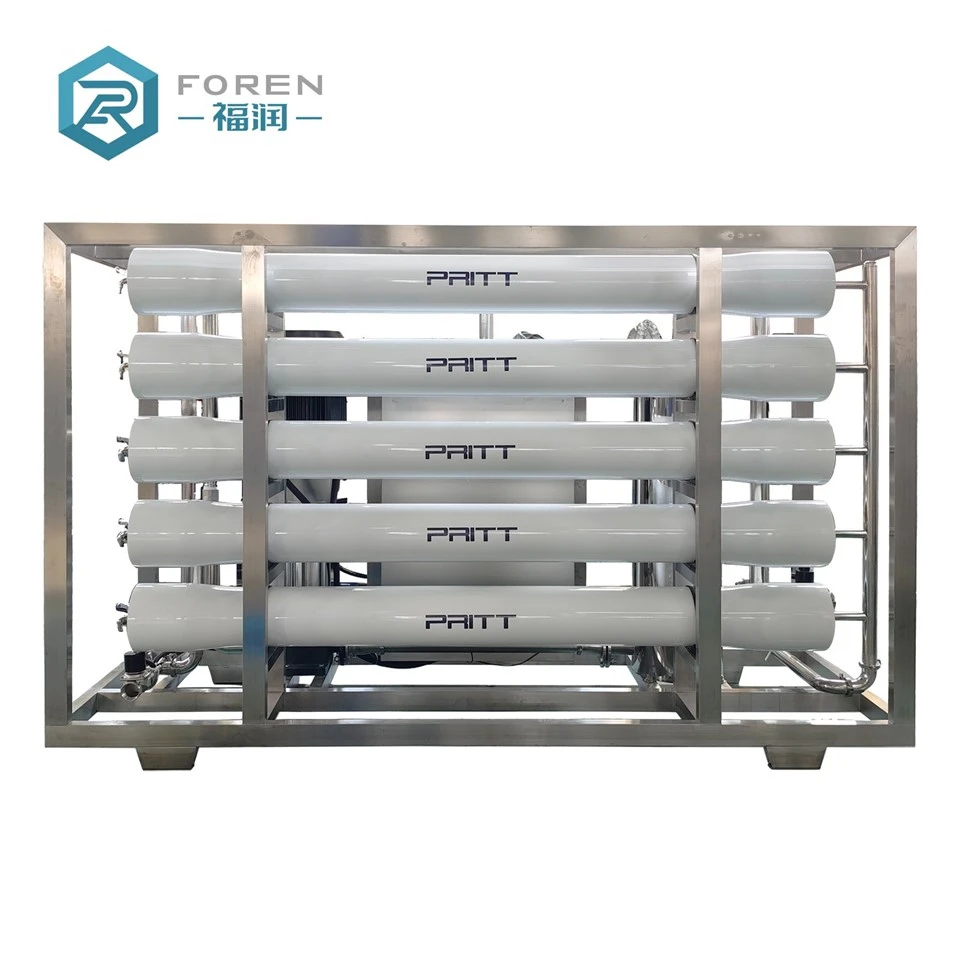
In terms of membrane housing configuration that customers often confuse, we have formed a clear matching standard through years of project practice. The two mainstream materials are fiberglass and stainless steel. Fiberglass membrane housings are cost-effective, corrosion-resistant and adaptable to most conventional water quality working conditions, so we take it as the default configuration for most industrial projects. For high-standard industries with strict hygiene requirements, such as food, beverage and pharmaceutical production, we uniformly configure stainless steel membrane housings, which support complete CIP online cleaning, no sanitary dead ends, and meet industrial hygiene certification standards. Meanwhile, combined with different water pressure working conditions, we can flexibly select membrane housings with pressure ratings of 150PSI, 300PSI, 450PSI, 600PSI and 1000PSI to ensure stable and safe equipment operation.

In terms of system configuration, we have always insisted that a qualified and durable RO system must have complete monitoring and protection functions, which is also the key difference between our customized equipment and ordinary standardized equipment. Based on years of after-sales maintenance experience, a fully functional RO system needs to be equipped with complete online monitoring devices: real-time conductivity monitoring for feed water, permeate and concentrate to grasp water quality changes in real time; matched inter-stage pressure gauges and differential pressure switches to monitor system operating pressure and avoid overload operation; precision feed water and permeate flow meters to count water production data; online pH monitoring device to facilitate real-time alkali adjustment and stabilize desalination efficiency; and ORP monitoring device to strictly control residual chlorine content and prevent membrane oxidation damage.
For industrial equipment that needs long-term continuous operation, we highly recommend configuring a complete automatic control system based on our practical operation experience. Equipped with PLC control system and touchscreen operation interface, the equipment can realize fully automatic unattended operation: automatic low-pressure flushing before startup, stable high-pressure operation during water production, automatic shutdown flushing after operation, and automatic discharge of unqualified permeate with excessive conductivity. This intelligent configuration not only reduces manual operation errors and labor costs, but also effectively avoids equipment aging and failure caused by irregular manual operation, greatly extending the overall service life of the system.