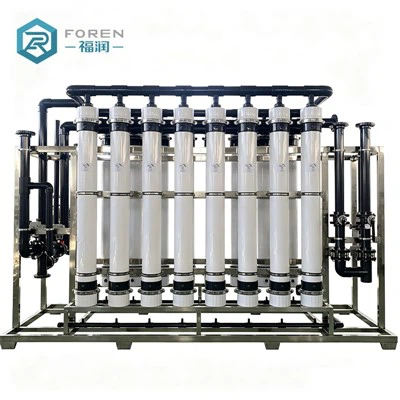

Simply put, "water treatment equipment" refers to devices that employ various physical and chemical methods to remove harmful or unwanted substances from water-substances that are detrimental to industrial production or daily life. Essentially, these are devices designed to filter and purify water. Given the intimate connection between water and both industrial production and daily living, the field of water treatment encompasses an extremely broad scope of applications, constituting a vast and extensive industry sector.
Working Principle
The pretreatment process for Reverse Osmosis (RO) systems primarily involves activated carbon filtration and fine filtration. Osmosis is a natural phenomenon: water passes through a semipermeable membrane, flowing from a side with a lower solute concentration to a side with a higher solute concentration, until the chemical potential of the solvent reaches equilibrium. At this equilibrium point, the pressure differential across the membrane equals the osmotic pressure. This constitutes the phenomenon known as the "osmotic effect" (Osmosis). Reverse Osmosis refers to the process whereby, if pressure is applied to the side with the higher solute concentration, the aforementioned osmotic effect can be halted and reversed; this forces the water to flow from the high-concentration side toward the low-concentration side, thereby purifying the water. This phenomenon is termed Reverse Osmosis (or "inverse osmosis"), and the semipermeable membrane utilized in this process is known as a reverse osmosis membrane.