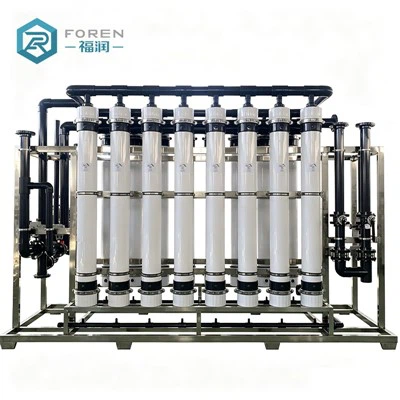

What Is a Multi-Media Filter?
A multi-media filter is an essential core pretreatment filtration equipment widely used in industrial water treatment and water purification systems. Under a certain operating pressure, raw water with high turbidity passes through a specific thickness of granular and special filter material layers inside the filter tank, and various suspended impurities, sediments and particulate contaminants in the water are effectively intercepted and removed through physical filtration, achieving the effect of rapid water clarification. This professional water filtration equipment adopts one or more composite filter media for layered purification, and the commonly used standard filter materials include quartz sand, anthracite, manganese sand and other high-performance filter materials. It is mostly used for key water treatment links such as raw water turbidity reduction, water softening treatment, and pre-treatment support for pure water and ultra-pure water production. After professional filtration by a standard multi-media filter, the final effluent turbidity can be stabilized below 3 degrees, fully meeting the water quality requirements for subsequent deep water treatment and industrial recycling water use.
Basic Definition and Core Function of Water Filtration in Water Treatment
In the entire water treatment process chain, filtration refers to a professional water purification process that uses filter material layers such as quartz sand and anthracite to intercept suspended solids, colloidal pollutants and tiny particulate matter in raw water to obtain clear and qualified water quality. All porous materials that can be used for water filtration and impurity interception are collectively called filter media, among which quartz sand is the most conventional and widely used basic filter material. Filter media on the market are available in granular, powdered and fibrous types, including mainstream specifications such as quartz sand, anthracite coal, activated carbon, magnetite, garnet, ceramic filter material and plastic balls.
Different from single-layer single-media filtration equipment, a multi-media filter, also known as a multi-layer filter bed, adopts two or more different filter media to form a composite filter layer. It is widely installed and used in industrial circulating water treatment systems, specially designed to remove solid impurities in sewage, adsorb floating oil and organic pollutants, and effectively improve water quality to meet the recycling standards of industrial production water. The core purpose of filtration is to remove suspended and colloidal impurities that are difficult to settle and remove through conventional sedimentation technology, especially tiny fine particles that affect subsequent water treatment effects, laying a solid foundation for the stable operation of subsequent RO reverse osmosis equipment and deep purification systems.
Key Selection Criteria for Qualified Filter Media

The performance of a multi-media filter directly depends on the quality of the selected filter media. To ensure long-term stable filtration effect, frequent backwashing resistance and long service life of the equipment, the selection of all filter materials must strictly comply with the following core standards:
- High mechanical strength: The filter media must have sufficient compression and wear resistance to avoid rapid wear, fragmentation and powdering during frequent backwashing and positive flushing cycles, preventing filter material damage and secondary water pollution.
- Excellent chemical stability: The selected filter materials will not undergo chemical reaction, dissolution or deterioration when encountering raw water with different water quality indicators, ensuring no change in filter material performance and no impact on water treatment safety.
- Safe and non-toxic material characteristics: The filter media shall not contain any harmful and toxic substances that endanger human health, nor include any components that interfere with industrial normal production and affect product quality, meeting the safety requirements of drinking water and industrial production water treatment.
- Superior filtration and water production performance: Prioritize filter media with strong adsorption capacity, high dirt interception capacity, large water production flux and stable effluent water quality, so as to improve overall filtration efficiency and reduce equipment operation and maintenance costs.
Among all supporting filter materials, pebbles mainly play a stable supporting role in the bottom of the filter layer. With high structural strength and stable gap spacing between pebbles, the large internal pores ensure the smooth passage of filtered water during positive filtration. At the same time, it can also ensure the smooth circulation of backwash water and backwash air during the backwashing process, avoiding filter layer blockage and backwashing dead angles. In conventional standard configuration, pebbles are divided into four different particle size specifications, and the laying method follows the principle of from large to small from bottom to top to ensure stable structure and uniform water flow distribution.
Common Types of Multi-Media Filters for Water Treatment
According to different raw water quality conditions and subsequent water production use requirements, multi-media filters are equipped with different combinations of composite filter media. The most common and practical types of multi-media filters widely used in the water treatment industry are as follows: anthracite-quartz sand-magnetite multi-media filter, activated carbon-quartz sand-magnetite multi-media filter, activated carbon-quartz sand dual-media filter, and quartz sand-ceramic multi-media filter. Users can select the appropriate filter combination according to actual water turbidity, impurity types and final water quality standards to achieve targeted filtration treatment.
Main Design Considerations for Multi-Media Filter Layers
The rational design of the filter layer is the key to ensuring the efficient operation of the multi-media filter and avoiding filter layer mixing and failure. The overall design must focus on the following three core factors: First, there must be a large density difference between different filter media materials, which can effectively prevent layer mixing and disorder of the composite filter media after backwashing disturbance and ensure the stable hierarchical structure of the filter layer. Second, the matching of filter media types must be based on the actual end-use purpose of the produced water to meet the personalized water purification needs of drinking water, industrial circulating water and pure water pretreatment respectively. Third, the particle size of the lower filter media must be smaller than that of the upper filter media, so as to give full play to the filtration efficiency of each filter layer and realize the full utilization of all filter materials.
Taking the conventional three-layer filter bed as an example, the upper layer is composed of light filter media with large particle size and low density such as anthracite and activated carbon, responsible for coarse filtration and intercepting large-particle impurities; the middle layer is dominated by quartz sand with medium particle size and moderate density for further fine filtration; the bottom layer adopts heavy filter media with small particle size and high density such as magnetite for deep precision filtration. The density difference design makes the filter media combination fixed and reasonable. The upper coarse filtration cooperates with the lower fine filtration to give full play to the comprehensive purification advantage of the multi-media filter bed, and the effluent water quality is far better than that of the single-layer filter bed. It is worth noting that for drinking water purification treatment scenarios, filter materials such as anthracite and resin are generally prohibited to ensure the safety and compliance of drinking water quality.