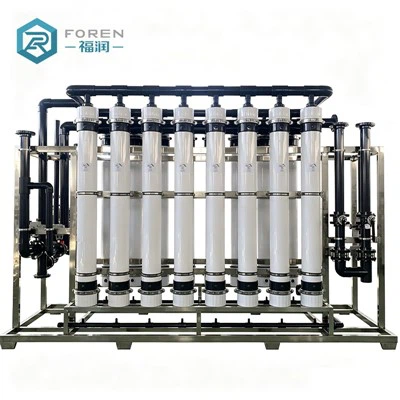

Reverse osmosis technology is based on the principle of selective retention using a semi-permeable membrane. It uses external force to drive water molecules to flow against the natural osmosis direction, achieving molecular-level separation of water and impurities. Water treatment equipment based on reverse osmosis technology can adapt to various water quality characteristics, ensuring stable and compliant effluent quality, meeting the water needs of various fields such as domestic and industrial use. Let's learn about the practical applications of reverse osmosis equipment under different water quality conditions: groundwater, tap water, and reservoir water.
1,Groundwater
In groundwater treatment, due to differences in geological conditions, groundwater quality fluctuates significantly and often contains a certain amount of dissolved salts, colloids, and small amounts of iron and manganese ions. Reverse osmosis equipment can be matched with corresponding pretreatment processes. It removes iron and manganese through manganese sand filtration, adds scale inhibitors to control calcium and magnesium ion scaling, and then uses a security filter to protect the membrane element, removing dissolved salts and colloidal impurities. The produced water can be used in rural centralized water supply, industrial boiler feedwater, and other scenarios, adapting to the characteristics of groundwater quality and achieving standardized utilization of water resources.
2,Tap water
After conventional treatment at water plants, tap water has relatively stable quality with low turbidity and suspended solids content, but still retains small amounts of residual chlorine, organic matter, and calcium and magnesium ions. For this type of water source, reverse osmosis equipment can be equipped with a simplified pretreatment process. Pretreatment is completed through multi-media filtration and activated carbon filtration, followed by further purification via the reverse osmosis system. The treated water can be used for direct drinking water supply, cleaning water in the electronics industry, etc., optimizing drinking water quality and meeting the pure water requirements of industrial production.
3,Reservoir water
Reservoir water, as a surface water source, is greatly affected by the natural environment and surrounding activities, resulting in frequent fluctuations in water quality and containing a high amount of suspended solids, algae, and organic matter. Reverse osmosis equipment can be equipped with a multi-stage pretreatment process. Turbidity is reduced through coagulation and sedimentation, algae and organic matter are removed by ultrafiltration and activated carbon filtration, and deep purification is achieved with anti-fouling membrane elements. The treated water can be used for municipal reclaimed water, industrial recycling, etc., meeting the water quality treatment needs of surface water sources.

Reverse osmosis equipment can adjust pretreatment schemes and system configurations according to the differences in water quality between groundwater, tap water, and reservoir water to complete water purification.
Qingzhou Foren Water Treatment Equipment Co., Ltd., as a factory with over 12 years of experience in manufacturing water treatment equipment, can design the most suitable water treatment solutions according to customer requirements. We analyze the local water quality, effluent quality requirements, and usage scenarios to recommend suitable water treatment equipment and solutions. We have a professional after-sales team, so you don't need to worry about machine usage issues.