
Notes from our lead field engineer, Qingzhou Foren Water Treatment Equipment Co., Ltd.
We first connected with this Mali-based investor earlier in the year. He'd been observing the local drinking water market for quite a while. Sachet water dominates daily consumption here, yet inconsistent hygiene standards keep creating consumer worries. He wanted to launch a bottled purified water brand and settled on a full production line making 1.5L PET bottles at 2000 units per hour. The scope covered everything from the raw water treatment skid, PET blow moulder, integrated rinse-fill-cap machine, cap feeder, lamp inspection bench, date printer, labeller through to the automatic palletizer.
He'd collected quotes from multiple equipment suppliers before reaching out to us. Most packages he received were built around standard configurations developed for well-controlled factory spaces - stable mains power, mild ambient temperature and low airborne dust. None of those proposals really addressed the harsh, variable operating conditions typical across the Sahel belt.
We reached an agreement and kicked off fabrication. Our workshop team ran complete pre-commissioning trials on every machine before container loading. Even so, when our engineers travelled out alongside the shipment, we only had standard drawings to reference. We knew Mali would throw up challenges, but we could not fully predict how several separate site issues would compound once we set foot on the ground.

The first big issue was seasonal raw water variation. Dry-season water from the Niger River and local boreholes carries elevated iron, manganese and coliform levels, even when silt loads stay low. Once the rainy season arrives, flood runoff washes huge volumes of sediment into the intake, sending turbidity soaring fast. A conventional pretreatment setup clogs rapidly under these swings. In practice, that means RO membranes foul within a handful of months, salt rejection drops, finished water fails quality checks, and the line keeps stopping for time-consuming chemical cleaning cycles.
Harmattan sand and extreme heat formed our second headache. The plant had no dedicated enclosed dust-proof passage, so fine Saharan sand blows freely across the workshop once the dry-season wind picks up. Daytime temperatures regularly climb past 45°C. This fine grit creeps into electrical control cabinets, the air compressor and the heating chambers of the bottle blowing machine. Dust buildup on contact points triggers random electrical shorts. Heating assemblies struggle to dissipate heat properly, filter cartridges block up repeatedly, and unplanned downtime becomes a regular hassle.
Third, the municipal power grid is underbuilt and unreliable. Voltage fluctuates constantly, and unexpected blackouts happen often with no backup stabilisation hardware. If power cuts mid-cycle, filling valves drip onto bottle necks, and standing water trapped inside pipework creates breeding ground for bacteria. In the worst cases, whole production runs get contaminated. Power surges damage servo motors, fill volumes drift out of tolerance, and the whole production sequence loses sync.
Fourth, the plant floor was a simple plain concrete slab without independent vibration bases. When the blow moulding machine, air compressor and filling unit run simultaneously, vibration transfers across the slab and amplifies. Over time, this shifts fill levels, causes crooked labels, loosens bolts and accelerates fatigue cracking on the machine frames.

Instead of forcing the site to adapt to our original factory design, we reworked parts of the installation to fit what we found on the ground, tackling each issue one after another.
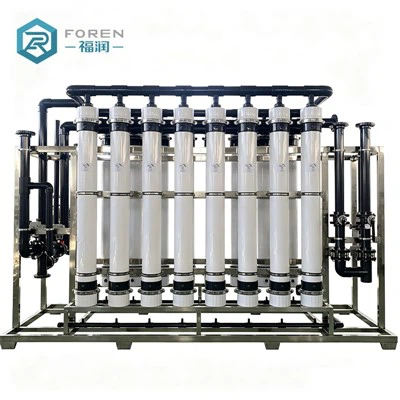
To handle the seasonal raw water swings, we added an inclined tube sedimentation stage upstream of the standard sand, carbon and softener filters, together with an automatic turbidity-activated diversion valve. This emergency bypass activates automatically when silt concentration spikes during rain events. After fitting this upgrade, the pretreatment train can cope with turbidity peaks up to 120 NTU. The RO system maintains salt rejection above 98.6%, finished water TDS stays below 45 mg/L, and overall recovery holds steady at 51%. We simulated flood conditions in a 72-hour continuous trial; the differential pressure rise across the RO stack was limited to 0.04 bar per day. We estimate this adjustment extends membrane service life by roughly 2.8 years and cuts the labour spent on monthly cleaning by around 62%.
We then addressed dust and thermal stress across the whole line. All control cabinets were upgraded to IP54 enclosures. The air compressor and blow moulding ovens received separate filtered air intake housings plus extra forced cooling ducts, and we fitted protective dust guards over exposed motor bodies. Our field logs showed cabinet dust ingress reduced by roughly 70%. Even with ambient temperature hitting 45°C, internal cabinet temperature remained below 42°C. The service interval for air filters stretched from weekly replacement out to 22 days. We kept the setup running nonstop for 14 days during active Harmattan winds and recorded zero electrical trips or heating faults.
For unstable power and sudden outages, we installed an industrial voltage stabiliser and energy buffer on the main supply, then revised the PLC program to manage power loss smoothly. The filling valves shut immediately and pipelines self-drain once supply fails, preventing drips and stagnant water. The system tolerates ±18% voltage variation; outside that range, it locks out to protect pumps and servo drives. When power returns, the equipment restarts step by step rather than energising every component at once. We carried out 16 separate power cut simulations and never saw contaminated bottle necks or out-of-spec batches.
Vibration control was the last modification. We cast separate reinforced concrete foundations for the bottle blower, air compressor and three-in-one filler, installing high-damping rubber isolators between each machine and its base to break vibration pathways. Before this change, peak combined vibration hit 2.1 mm/s; after installation, readings settled consistently under 0.7 mm/s. Fill error for the 1.5L bottles stayed within ±12 ml. We completed a 72-hour full-speed run at 2000BPH, label offset remained less than 2 mm, and we did not see recurring loose fasteners.

Once all adjustments were signed off, we kicked off a three-day continuous acceptance run at the target 2000 bottles per hour. We kept detailed running logs throughout this test period for the client's management team to review.
• Steady throughput: 2000BPH for 1.5L PET bottles, with average operational uptime reaching 94.2%
• Fill specification: nominal 1.5L volume, batch variation controlled within ±12 ml
• Finished purified water: TDS 32–44 mg/L, salt rejection above 98.6%, compliant with West African bottled drinking water standards
• Process sequence: raw water pretreatment + RO reverse osmosis → PET bottle blowing → rinse / fill / cap → cap feeding → manual lamp inspection → date coding → labelling → palletising
• Training and handover: We spent several days working side-by-side with eight local operators and two maintenance technicians. Before leaving site, we handed over French operation manuals, spare parts schedules, electrical drawings and written CIP cleaning procedures.

This project reinforced a lesson we keep learning working across West Africa: standard bottling lines almost always need custom tweaks before they can perform reliably locally. Investors and plant operators across the Sahel regularly run into overlapping challenges: silt-heavy source water after rains, persistent dust and high heat, fragile power grids and basic concrete slabs built without vibration considerations. A filling line that runs smoothly in a climate-controlled domestic workshop will keep breaking down in these conditions unless risks are mapped out early and the design adjusted accordingly. Unplanned repair bills and lost production can quickly add up to a sum higher than the original equipment cost.
At Qingzhou Foren Water Treatment Equipment Co., Ltd., our workflow for African water projects always starts with gathering real site data first. We ask for complete water analysis reports, power supply parameters and foundation drawings before finalising layouts. Only then do we design dust protection, vibration damping, power stabilisation and pretreatment upgrades, instead of simply dispatching a standard build.
These field notes are written for anyone planning small purified water bottling ventures in the Sahel - plant owners, investors and operational managers based in Mali, Burkina Faso, Niger and nearby territories.

If you are exploring a bottled water project in West Africa, whether you need a full 1.5L or 500ml bottling package or standalone RO and filling equipment, share your water test report, target capacity and site power details with us. We will assess your site constraints and develop a practical solution, including overseas installation, commissioning and hands-on operator training for your local team.