
Qingzhou Foren Water Treatment Equipment Co., Ltd. | Engineering Case Record
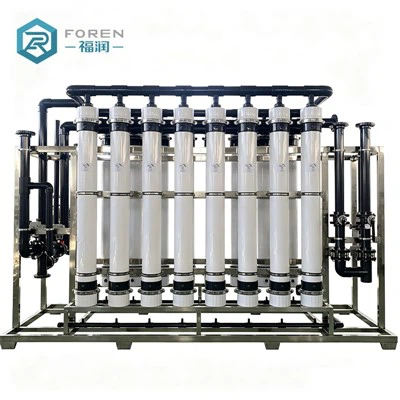
Our workshop has been focused on a pure water system destined for Zambia these days. When we received the inquiry in early November, our engineering team was well aware that projects for inland Africa cannot be built simply by copying standard drawings. The end client is a local food manufacturer; the treated water will be directly used for food rinsing, ingredient mixing and product filling, which calls for reliable hygienic water quality. The final solution is a 10 m³/h single-stage reverse osmosis system, consisting of raw water tank, RO main unit, purified water tank and integrated ozone generator. All wetted components are constructed from food-grade stainless steel. This week, we finished full assembly and launched the integrated factory acceptance test.

Many suppliers exporting water treatment units tend to adopt standard designs directly. Standard RO units and their parameter settings are developed under ideal conditions: stable raw water quality, consistent power supply and experienced on-site maintenance teams. Such units perform well in well-equipped domestic workshops, yet conditions in Zambia differ greatly. This was the core topic in our design review meeting. We identified four hidden risks that are frequently overlooked but will determine long-term operational stability. Corresponding optimizations were embedded into fabrication, so we mitigate risks at our factory instead of arranging costly rework after the container arrives on-site.

The first challenge comes from raw water. Well water or surface water in Zambia changes dramatically across seasons. During rainy seasons, suspended solids, colloids and organic load surge rapidly, which causes rapid fouling of RO membranes, rising differential pressure and shortened membrane service life. To tackle this, we reserved expansion ports for pre-treatment, chemical dosing points and online sampling ports on the skid. We also optimized the concentrate recirculation pipeline and installed differential pressure transmitters with preset alarm thresholds. Once raw water deteriorates on-site, the client can quickly add supplementary pre-treatment modules to slow membrane fouling.
The second unavoidable pain point is unstable grid power. Voltage fluctuation, sag and unexpected power cuts happen frequently. Frequent electrical shocks will harm the high-pressure pump, trigger false alarms or even burn out the motor and permanently damage RO membranes. We upgraded the electrical package with soft starters for high-pressure pumps and an integrated protection controller for phase loss, overvoltage and undervoltage. Interlock logic is programmed in the control system for automatic shutdown under abnormal supply to safeguard core components.


Third, corrosion control and hygienic compliance matter for long-term operation. Inland Zambia maintains high ambient temperature year-round, which accelerates degradation and corrosion of ordinary materials. To meet food-grade requirements, all wetted parts are made of 304 stainless steel. Tanks are internally polished with passivated weld seams. Sanitary clamp connections and high-temperature resistant EPDM gaskets are adopted to eliminate secondary contamination caused by rust and satisfy food processing water standards.
Fourth, a realistic constraint for African projects is limited availability of skilled water treatment technicians. Complicated piping layouts and complex operating sequences will make routine cleaning and troubleshooting difficult. Therefore, we streamlined the layout. All transmitters and gauges are centralised on the control panel. Every pipeline is clearly labelled, CIP ports are fitted with quick connectors, and common spare parts are selected for easy local procurement, lowering maintenance barriers.

After assembly, we carried out continuous integrated commissioning including the ozone generator, the key work of our workshop this week. Test results show stable performance. The designed capacity is 10 m³/h, and the stable output ranges from 10.1 to 10.4 m³/h. The single-stage RO salt rejection remains above 97.5%, system recovery is controlled between 50% and 55% to match local TDS levels. Permeate TDS is kept below 60 mg/L, fully complying with process water requirements for food production. The ozone unit can be activated on demand to inhibit microbial growth inside the purified water tank and prevent recontamination of stored pure water. We simulated power failure and low-pressure scenarios repeatedly during FAT. Safety interlocks responded reliably, no leakage was detected, pressure curves stayed smooth and running noise was limited within 76 dB. All instruments were calibrated. PID drawings, electrical schematics, material certificates and operation manuals are being compiled and will be shipped together with the equipment to Zambia.

From years of experience in overseas water treatment projects, we have learned that most breakdowns after shipment are not caused by defective RO membranes. Failures usually stem from generic design without consideration of real site conditions. For food factories in inland Zambia and similar African regions, hygienic construction, electrical surge protection, flexible pre-treatment space and user-friendly operation are far more important than nominal parameters. By completing optimizations and FAT at our factory, we help cut on-site commissioning time and support faster production startup for our client.
If you are sourcing pure water solutions for food or beverage factories in Africa and require custom food-grade stainless steel RO systems of 5 m³/h, 10 m³/h or 20 m³/h, optional with ozone disinfection or EDI modules, contact Qingzhou Foren Water Treatment Equipment Co., Ltd. Simply share your raw water analysis report, and we will deliver a site-adapted process proposal and quotation.
Recommended Related Cases:
· 10 m³/h Single-Stage RO Food-Grade Pure Water System
· Export Water Treatment Projects for Africa
· Integrated Stainless Steel Tank + UV Pure Water Solution