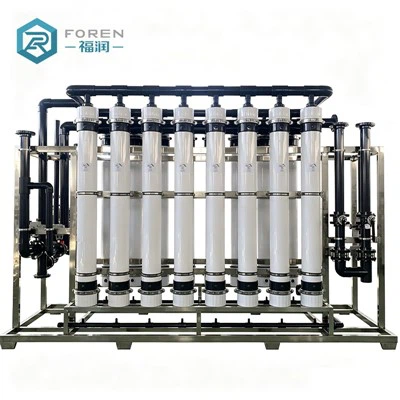

Water is the source of life and the foundation of industrial production and public welfare. Reverse osmosis technology, with its advantages of purification and energy efficiency, has become a pillar of modern water treatment. Currently, the mainstream single-stage and double-stage reverse osmosis technologies on the market, while both employing reverse osmosis, differ in process design, purification effect, and application scenarios, enabling them to meet the water needs of different industries and provide diverse solutions for the high-quality development of the water treatment industry.

The difference between single-stage and double-stage reverse osmosis lies primarily in the complexity of the process flow. Single-stage reverse osmosis employs a "one-step" purification process. The entire system consists of pretreatment, filtration, a high-pressure pump, and a single reverse osmosis membrane module. After pretreatment to remove large particulate impurities, the raw water is pressurized and fed into the reverse osmosis membrane by the high-pressure pump. Through the selective separation of the membrane, primary filtration is completed, directly producing water that meets basic purification standards. This process is simple, with a straightforward pipeline layout, small footprint, and low requirements for the installation environment, enabling rapid fulfillment of basic water purification needs.
Double-stage reverse osmosis is a significant upgrade from single-stage technology, employing a "dual filtration" design. It adds a second high-pressure pump and reverse osmosis membrane modules to the single-stage system, and some models also include an intermediate water tank to stabilize the quality of the first-stage permeate. The process involves pre-treating raw water, first undergoing initial purification through a single-stage reverse osmosis system, and then pressurizing the first-stage permeate before being sent to a second-stage reverse osmosis membrane for further filtration, removing residual impurities and ultimately producing water with higher purity. This dual filtration design provides "double insurance" for water purification, but it also makes the equipment structure more complex and requires a larger footprint.
The key difference between the two lies in the purification effect and desalination rate. Single-stage reverse osmosis maintains a stable desalination rate of 90%-98%, effectively removing most dissolved salts, heavy metal ions, organic matter, and colloidal impurities from the raw water, sufficient to meet basic water purification needs. Its energy consumption is low, requiring only one high-pressure pump to operate. Initial purchase and subsequent maintenance costs are relatively controllable, making it suitable for scenarios with good raw water quality and low requirements for product water purity.
Double-stage reverse osmosis, with its advantage of secondary filtration, can increase the desalination rate to over 99.5%, further removing trace amounts of salt and residual impurities not filtered out by the single-stage process. This results in purer product water that meets higher water quality standards. Simultaneously, the dual-stage system is more adaptable to different raw water qualities; even with large fluctuations in raw water quality, dual purification ensures stable product water quality. However, its energy consumption is 15%-30% higher than the single-stage system, and initial purchase and subsequent maintenance costs are also relatively higher.
The difference in adaptability between the two is particularly significant in application scenarios. Single-stage reverse osmosis, with its high cost-effectiveness and simple process, is widely used for cooling water in general industrial production, workshop cleaning water, hotel room washing water and employee tea room drinking water in commercial scenarios, and household non-direct drinking water purification, making it the preferred solution for small and medium-sized users.
Double-stage reverse osmosis is primarily designed for applications with high water quality requirements, including chip cleaning water in the electronics industry, formulation water in the pharmaceutical industry, experimental water in laboratories, and deep purification in drinking water plants. These scenarios have extremely high requirements for the salinity and heavy metal content of the water. The deep purification capabilities of two-stage reverse osmosis ensure that the produced water meets standards, preventing water quality issues from affecting product quality or experimental accuracy.

In fact, there is no inherent superiority of single-stage or Double-stage reverse osmosis technology over its superiority; the key lies in adapting to specific needs. With continuous innovation in water treatment technology, both technologies are constantly being upgraded in terms of energy efficiency and stability. For example, the application of anti-fouling coating technology effectively extends the lifespan of membrane modules and further reduces operation and maintenance costs. In the future, as water standards across various industries continue to rise, reverse osmosis technology that matches specific needs will continue to play a vital role, injecting new momentum into water resource utilization and environmental protection.