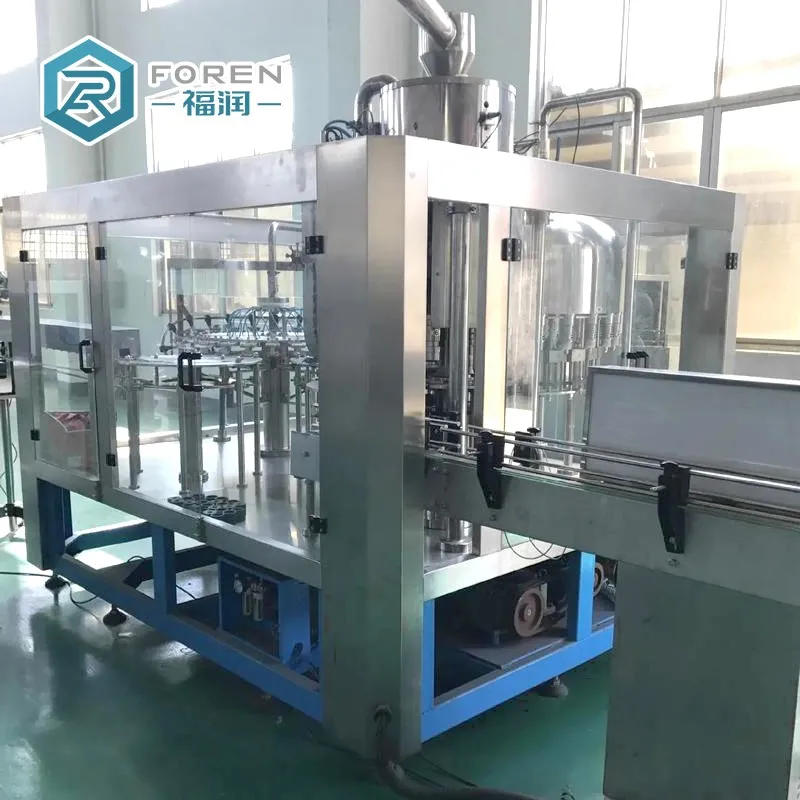

Fruit juice filling machines fall into two categories: cold filling and hot filling.
In cold filling, the product undergoes ultra-high-temperature (UHT) sterilization and is cooled to ambient temperature. It is then filled-within a controlled aseptic environment-into bottles or cartons that have been sterilized with hydrogen peroxide; the caps are also sterilized with hydrogen peroxide before being screwed on. Cold filling has a minimal impact on the product's taste and nutritional quality and requires less PET material, though the initial equipment investment is roughly double that of hot filling.
In hot filling, the product is sterilized at high temperatures and filled into bottles at approximately 90°C. After capping, the heat from the product itself performs a final sterilization of the bottle and cap. Because the product remains at a high temperature for an extended period, this process has a more significant impact on taste and nutritional content.

Fruit Juice Filling Production Line Workflow:
1. Dilution: Dilute the thawed fruit juice concentrate with purified water according to the formula requirements.
2. Filtration: Remove suspended solids and impurities from the juice to ensure the diluted juice is clear and transparent.
3. Homogenization: Homogenize the diluted juice to ensure uniformity and stability. Required homogenization pressure: 20–25 MPa.
4. Sugar Dissolution and Filtration: Performed in a sugar dissolution tank. Start the agitator, add the appropriate amount of water, and add granulated sugar according to the formula. Sugar dissolution can be done via hot or cold methods; the choice depends on production process requirements. Diatomaceous earth filtration is typically used for the sugar solution. The dissolution and filtration processes for other auxiliary ingredients are essentially the same as those for granulated sugar.
5. Blending: Pump the diluted juice, the dissolved and filtered sugar solution, and the dissolved and filtered auxiliary ingredients into a blending tank. Mix thoroughly and adjust to the final volume. Add flavorings and/or colorants according to the formula and mix well.
6. Filtration: Pass the blended mixture through an inline filter housing to completely remove any remaining suspended solids or impurities, ensuring the product is transparent, uniform, and free of sediment. 7. Sterilization: Pass the filtered liquid through a UHT sterilizer. Sterilization conditions: 130–135°C for 4–6 seconds. Ensure the steam pressure supplied to the sterilizer is at least 0.8 MPa.
8. Washing: Pass bottles through a bottle washer to thoroughly remove any dust or contaminants. To ensure effective cleaning, the purified water pressure must be at least 0.4 MPa. Bottle washing is often integrated with filling and capping to form a "three-in-one" filling machine.
9. Filling and Capping: There are two main filling methods: aseptic cold filling and aseptic hot filling. To ensure quality, fruit juice beverages typically use aseptic hot filling, requiring a filling temperature of at least 90°C and a post-filling internal bottle temperature of at least 85°C. Cap immediately after filling, adjusting the capping head to the appropriate torque to ensure a tight seal. A "three-in-one" hot filling machine handles washing, filling, and capping.
10. Bottle Inversion: Immediately pass the hot-filled product through a bottle inverter to turn the bottles upside down; this allows the residual heat of the liquid to sterilize the bottle and cap, ensuring product quality.
11. Light Inspection: Pass the product through a light inspection machine to check for contaminants or impurities and verify the integrity of the seal, ensuring only qualified products proceed to the next stage.
12. Cooling: Pass the product through a cooling tunnel to rapidly lower its temperature to (38 ± 2)°C. (Note: Hot filling equipment requires lower initial investment.)