
In the actual production of bottled water, washing recovered containers is a crucial step in the production line that cannot be overlooked. After transport and circulation, the inner walls of recovered containers often retain water stains and limescale, while the openings are prone to dust and microbial contamination; if the washing process is poorly designed, ensuring product hygiene during subsequent filling becomes difficult. Drawing on experiences with various clients, Foren has outlined key technical points regarding container washing for bottled water lines to assist technical personnel at water plants.
First, recovered containers cannot be fed directly into the filling unit upon arrival at the plant. Preliminary external processing is required: damaged or severely moldy containers must be removed manually or via equipment, and mud or stains on the outer walls-as well as residual adhesive at the opening-must be scrubbed off. If heavily soiled containers enter the washing unit directly, the resulting influx of impurities places an excessive burden on internal spray piping, shortens the lifespan of the washing solution, and frequently causes nozzle clogs. Proper pre-treatment reduces the workload on the main washing unit and enhances the overall effectiveness of the washing process.
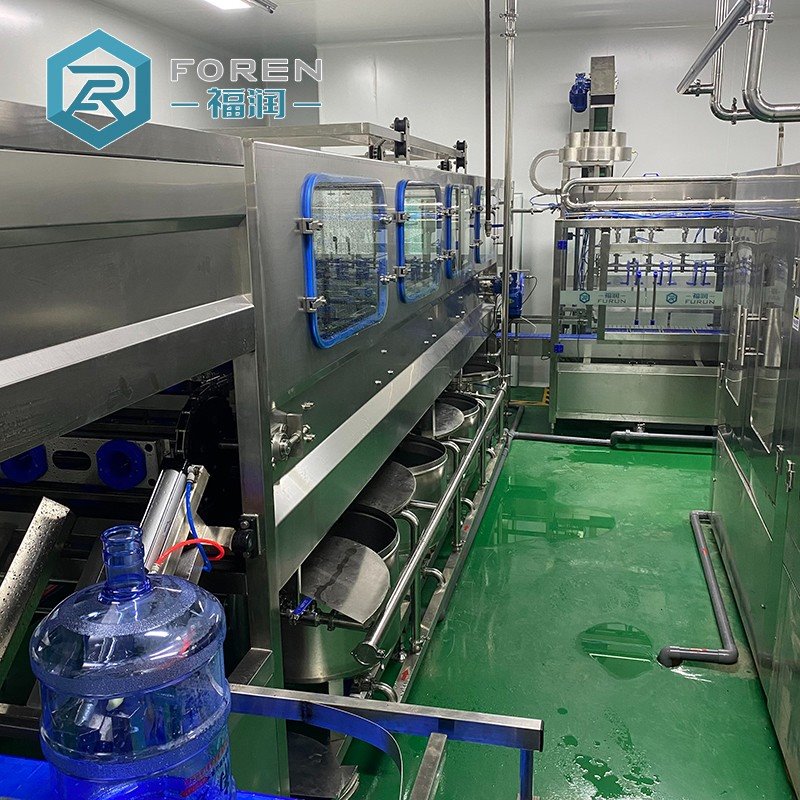
The cleaning process for recovered containers consists of two stages: external washing and internal washing. The internal washing phase involves alkaline washing, spraying, chemical soaking, and multiple stages of fresh water rinsing. Areas such as the threaded neck and the recessed groove at the bottom of PC containers are "dead zones" that are difficult to clean. Therefore, the spray nozzles in the filling equipment must be positioned to cover these critical areas, ensuring that the wash water directly targets the neck threads and the bottom groove.
Once the washing process is complete, a draining station is required to fully evacuate any residual wash water from the containers.
The condition of recovered containers varies by region; some have undergone few cycles and are only lightly soiled, while others have been in circulation for years and exhibit heavy limescale buildup on their inner walls. The washing parameters of bottled water filling equipment-such as alkaline wash duration and spray pressure-can be flexibly adjusted based on the actual condition of the recovered containers. For batches with heavy soiling, a pre-treatment step can be added; rather than relying solely on the main machine for intensive cleaning, this approach ensures a high cleaning pass rate.
The equipment manufactured by Foren covers all aspects of barrel production; we tailor the most suitable bottled water production solutions to meet our customers' specific requirements.