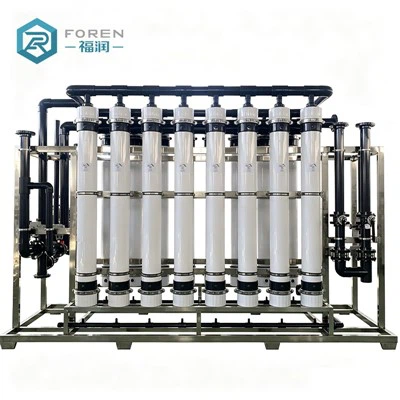

In many rural areas, farms, and factories across the country, groundwater serves as the primary source of water for operations. However, groundwater often suffers from issues such as high sediment content, turbidity, yellowish discoloration, and noticeable odors. Using untreated groundwater directly can not only hinder operational efficiency but also adversely affect equipment and the farming environment.
Qingzhou FOREN Water Treatment Equipment Co., Ltd. customized a reverse osmosis (RO) pure water system for a client in the aquaculture industry. This solution successfully resolved the issues of turbidity and discoloration, ensuring a stable supply of high-quality pure water-all while maintaining extremely low long-term operating costs.

First, let's understand why groundwater turns yellow and turbid.
As groundwater percolates through geological strata over long periods, it picks up various impurities-such as sediment, suspended particles, metal ions (like iron and manganese), organic matter, odor-causing substances, bacteria, microorganisms, and dissolved salts. These impurities cause the water to become yellow and turbid, negatively impacting subsequent production processes and usage.
For the aquaculture industry, the long-term use of untreated groundwater can compromise the quality of drinking water for livestock, increase disease risks, and ultimately reduce farming profitability.
To address the client's specific challenges-namely high sediment content and poor water quality-we designed a comprehensive reverse osmosis water treatment system.
In the first stage, raw water enters a quartz sand filtration tank. This step primarily removes large particles such as sediment and rust, reduces turbidity, and protects downstream equipment.
The system utilizes an automatic control valve that performs backwashing based on preset schedules, eliminating the need for frequent manual cleaning and significantly lowering maintenance costs.
In the second stage, the sand-filtered water passes through an activated carbon filter. This stage removes discoloration and odors, adsorbs organic pollutants, and reduces residual chlorine levels. This further purifies the water, ensuring optimal feed-water conditions for the RO membrane system.
The third stage-the core of the system-employs four high-performance RO membranes for advanced purification.
With a filtration precision of 0.0001 microns, the RO membranes effectively remove bacteria, viruses, heavy metals, dissolved salts, and organic pollutants. The resulting purified water meets the requirements for applications such as aquaculture, food processing, and industrial production.

With over a decade of experience in the water treatment equipment manufacturing industry, our factory specializes in tailoring reverse osmosis water treatment systems to meet specific client needs-factoring in raw water quality, daily water consumption, output specifications, and installation site conditions.