

The 3-in-1 filler refers to the core machine for bottle rinsing, filling and capping. A full production line covers the whole process from raw water treatment to finished product palletizing.
Working principle of 3-in-1 unit: Empty bottles are conveyed by star wheels and clamped for inverted bottle rinsing with sterile water. After draining, bottles return upright to filling station. Neck holders fix bottles while cam opens filling valves for gravity filling. Then bottles go to capping station, where cap sorter arranges caps and constant-torque capping heads seal bottles. Capacity is determined by the head configuration of rinsing, filling and capping sections.
For new water plants, complete lines are recommended. If water treatment and downstream packaging equipment are already available, customers may purchase the standalone 3-in-1 filler only.
Applicable Liquid & Bottle Types
This machine is designed for non-carbonated drinking water including purified water, mineral water and spring water. Carbonated drinks, fruit juice and dairy products require dedicated filling equipment with different filling valves and sterilization systems.
Standard automatic models support bottle sizes: 200ml–2L small bottles, 2L–10L large bottles and 3–5 gallon barrels. Compatible bottle diameter: Φ50–Φ100mm, bottle height:150–330mm with standard plastic screw caps. Round and square bottles are acceptable. Liquid level deviation can be controlled within ±3mm.
Custom fittings are required for special-shaped bottles, wide-mouth bottles and glass bottles. Bottle diameter and neck specification shall be confirmed in advance to avoid mismatching of bottle handling parts.
Note: 3–5 gallon barrel filling line is independent and incompatible with small bottle equipment.

Configuration of Complete Production Line
A stable bottled water line contains six modules. Mismatched capacity among units will cause bottlenecks in production.
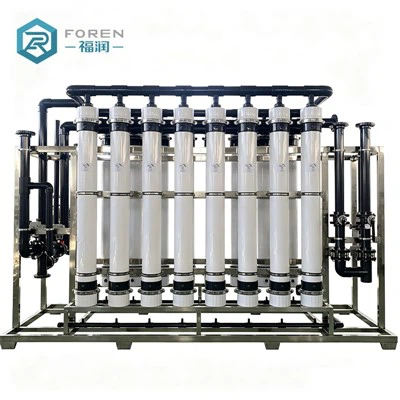
Purifies raw water to meet drinking standard. Standard process: multimedia filter, activated carbon filter, water softener and RO system, equipped with ozone or UV sterilization. Activated carbon removes residual chlorine, protects RO membranes and improves water taste. Purified water adopts RO for mineral removal; mineral / spring water uses ultrafiltration to retain minerals, subject to stable raw water quality and complete source approval documents.


Converts PET preforms into bottles. Linear and rotary types available, with capacity matching the 3-in-1 filler.
Core unit of the whole line.


Labeler can be fitted for self-adhesive, sleeve or hot-melt labels; inkjet printer prints production date and batch number.
Including film wrapping machine and carton packer. Cost reduction by removing packaging equipment may lead to finished bottle accumulation.


Improves warehouse outbound efficiency.
Filling Accuracy & Anti-leakage Control

Stable performance relies on filling valve structure, bottle neck positioning and capping torque control.
Volumetric filling valves are adopted for gravity filling. When bottles move away, valves close automatically. Filling volume can be adjusted via HMI for consistent liquid level.
Bottles are conveyed by neck holders instead of bottom support, ensuring stable neck position and lowering cross-contamination risk.
Constant-torque capping heads maintain consistent tightness regardless of cap batch variation, keeping capping reject rate at a low level.
Optional safety functions: no-bottle stop, no-cap detection, automatic water level control, auto-rinse stop and production counter. Parameters can be checked and modified on HMI to simplify commissioning.
Workshop & Utility Requirements
Machine dimension: height 2200–3000mm, weight 4–25 tons. The workshop shall reserve sufficient headroom for piping and hoisting. Floor needs hardening and drainage. Space for preform storage and finished goods handling should be reserved for line layout.
Power: main unit rated power ranges from 3kW to 18.5kW. Total transformer capacity shall be reserved at 1.2–1.5 times of total connected load including blowers, air compressors and packaging machines. Air supply: 0.6–0.8MPa with air receiver tank.
Quotation Checklist
Total price alone is insufficient for comparison. Quotation shall specify: model & head configuration, wetted material, electric component brand, inclusion of bottle blower, downstream packaging list, water treatment capacity, spare parts and on-site training service.
Blow-Fill-Seal Monoblock vs 3-in-1 Filler
Blow-fill-seal monoblock suits limited workshop space and fixed bottle specifications.
3-in-1 separate unit is recommended for frequent bottle change and phased capacity expansion. The intermediate empty bottle conveyor provides buffer capacity, and maintenance on single unit will not shut down the whole line.
FAQ

01. Difference between mineral water line and purified water line
02. Troubleshooting for liquid dripping
03. Balance capacity of each process